
Education
Use AI responsibly, Bingham VC tells scholars at joint postgraduate training

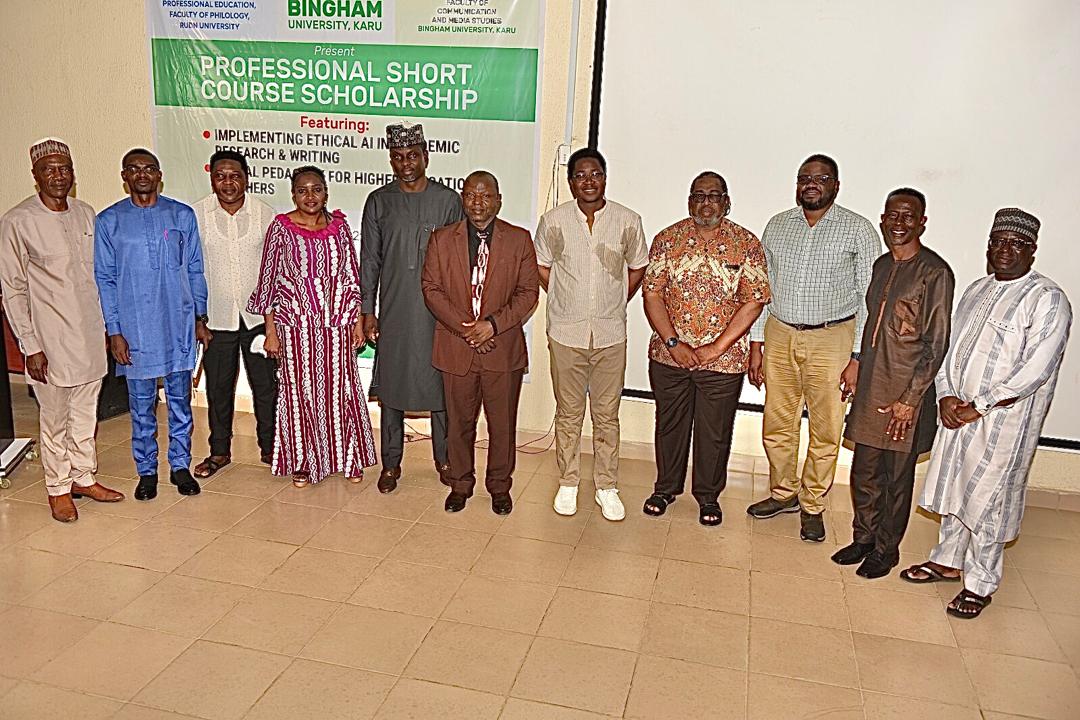
The Vice-Chancellor of Bingham University, Karu, Nasarawa State, Prof. Haruna Ayuba, has urged academics and students to adopt artificial intelligence responsibly and ethically in research and writing, stressing that technology must be guided by moral standards and human values.
Ayuba made the call during a postgraduate training programme organised by the Faculty of Communication and Media Studies, Bingham University, in partnership with the Centre for Continuing Professional Education, Faculty of Philology, RUDIN University, Russia.
He described the collaboration as a demonstration of academic excellence and global partnership, noting that it offers opportunities for knowledge sharing, capacity development and the responsible application of emerging technologies.
“In an era marked by rapid technological advancement, the integration of ethical AI in academic research and writing, along with innovative digital pedagogy, has become essential for shaping the future of higher education,” he said.
The Vice-Chancellor observed that artificial intelligence is increasingly becoming standard practice in academic circles, adding that its growth and application must remain responsible, fair, transparent and respectful of human rights.
“If academicians can minimise harm, prevent bias, protect privacy and promote fairness and accountability in AI applications, we would have won a major battle,” he added.
Earlier, the Dean of the Faculty of Communication and Media Studies, Prof. Desmond Okocha, said artificial intelligence now plays a leading role across many sectors, particularly education, which he described as the backbone of all others.
He pointed out that conversations around AI usually address less than 10 per cent of its entire ecosystem, urging scholars to gain deeper understanding of its structure, tools, benefits and legal dimensions.
Okocha stressed that AI is not a single, uniform application, noting that it can be applied at different phases of academic work, including idea development, research, assignments and dissertations.
“AI has come to stay, but it will never replace humans. It will only extend the capacity of humans to function within their environment,” he said.
Also speaking, Associate Professor at RUDIN University, Russia, Mustapha Jamiu, said the training forms part of a scholarship-based short course aimed at improving the skills of staff and students in African universities.
He explained that the programme, which started in 2023, is being hosted by eight universities across Nigeria within a few weeks.
Jamiu added that the Bingham University session focuses on the application of ethical AI in academic research and writing, with postgraduate students and scholars as the target audience.
“The fact is that AI is here to stay. We cannot stop students from using it. The only thing we need to do is to work with it as a tool of this era,” he said.
In his remarks, the Director, Centre for Digital Divide and Social Informatics, Kaduna State University, Prof. Ayodele Joseph, cautioned that although AI offers advantages, misuse could encourage academic laziness.
“There’s nothing bad about using AI, but it should be done ethically. Students should know how to use AI and not allow AI to use them,” he said.
He advised students to cross-check information produced by AI tools and ensure their academic work remains original and accurate.


Use AI responsibly, Bingham VC tells scholars at joint postgraduate training

Adeyanju calls on DSS, EFCC to Probe El-Rufai over corruption and insecurity allegations

Judge steps aside in Malami’s ₦213bn EFCC forfeiture suit (SEE REASON)

Food and beverage Workers occupy NAFDAC Lagos office over sachet alcohol ban

‘Dawson’s creek’ star James Van Der Beek dies at 48

Miyetti Allah addresses US sanctions threat linked to terrorism claims

2027: Why ADC lacks strong unifying figures — Datti Baba-Ahmed

BREAKING: Senate adopts electronic, manual transmission of election results

Ganduje’s son distributes solar kits, irrigation pumps to Kano farmers, SMEs

Naira outperforms Dollar in remarkable comeback

FG to commence sale of state-owned assets – Minister

How EFCC arraigned suspects who allegedly collected ₦603m from a Woman to facilitate NNPC GMD Appointment

Electoral Act Amendment: ‘Akpabio is the real issue, Tinubu’s lapdog’ — El-Rufai


