
The Nation
Why petrol, diesel, LPG prices will continue to fall nationwide – FG

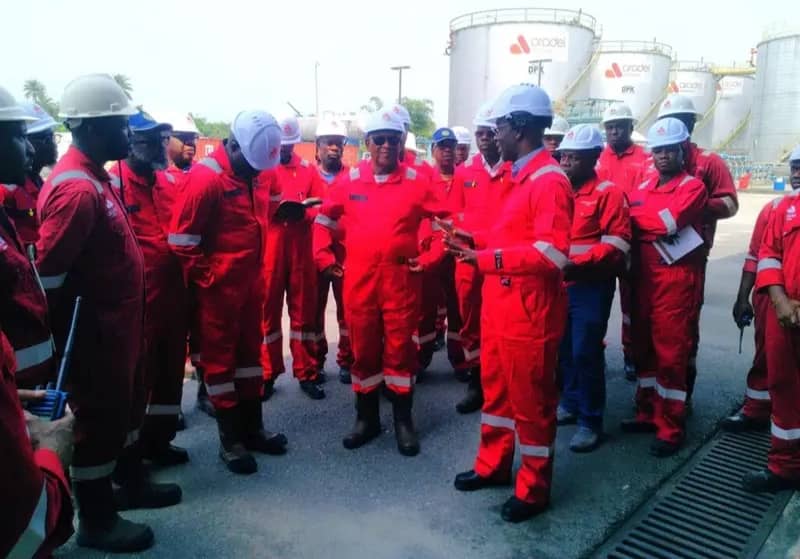
The Federal Government has said that the prices of petrol, diesel and Liquefied Petroleum Gas (LPG) are expected to continue falling across the country.
The Nigerian Midstream and Downstream Petroleum Regulatory Authority (NMDPRA) made this known through its Chief Executive, Mr Saidu Mohammed, during an inspection of facilities operated by Aradel Holdings Plc in Ogbele community, Ahoada East Local Government Area of Rivers State, on Sunday.
Mohammed attributed the anticipated reduction in prices to increased supply levels, heightened competition and sustained investments by private sector players in the oil and gas industry.
He said the trend signaled a gradual shift toward affordable energy for Nigerians, noting that improved availability was already contributing to price stability nationwide.
“The more supply we have, the lower the price, and this is already evident as petrol has dropped from about N1,000 to N800 per litre due to competition,” he said.
According to him, the removal of fuel subsidy had created room for market forces to operate effectively, leading to greater efficiency in the downstream segment of the industry.
“Sustained competition, rather than subsidies, will guaranty adequate supply of petrol and gas at affordable prices for Nigerians,” Mohammed added.
He emphasised the importance of establishing more refineries equipped with advanced conversion capacity capable of producing diesel, fuel oil, naphtha, LPG and petrol.
Mohammed said the country was positioning itself not only to satisfy domestic consumption but also to export petroleum products to markets in Africa, Europe and the Americas.
“However, domestic demand must first be adequately met by local operators before large-scale exports can commence,” he said.
He further noted that President Bola Tinubu remained a strong advocate of a free-market economy, recalling that the removal of fuel subsidy was the President’s first major policy decision.
Mohammed said the policy decision opened the sector to private investment and stimulated growth across the entire oil and gas value chain.
Speaking on state-owned refineries, he said their operational status was largely under the purview of the Nigerian National Petroleum Company Limited (NNPCL).
He added that the NMDPRA was working with the NNPCL to ensure the delivery of crude oil and petroleum products to the Port Harcourt and Warri refinery reserves.
“Delivery of products to the reserves and restoring loading activities at the refineries will boost local economies and revive product distribution within host communities.
“Once product loading resumes, Nigerians will begin to feel the economic impact, even before full refinery operations,” he said.
Mohammed also said Nigeria’s economic growth relied heavily on the rapid development of indigenous midstream infrastructure.
According to him, facilities inspected during his three-day operational tour of Rivers State showed that Nigerian companies possessed the technical and financial capacity to design, build and sustainably operate world-class energy assets.
He singled out Aradel Holdings, noting that the company had demonstrated the ability of Nigerians to efficiently run a refinery on a sustainable basis without foreign operatorship.
Mohammed disclosed that ongoing expansion work at Aradel would make it possible for petrol loading to begin from the facility before the end of 2027.
“Aradel has supplied gas to Nigeria Liquefied Natural Gas (NLNG) for about 13 years, alongside also operating an 11,000-barrels-per-day refinery.
“The company also runs a virtual gas pipeline, producing compressed natural gas distributed across several parts of Nigeria,” he said.
He called for more investments in refining capacity, stressing that the Dangote Refinery alone could not meet domestic, continental and global demand.
Describing the midstream segment as a major driver of economic growth, Mohammed said it had the potential to stimulate manufacturing, power generation, transportation and other productive sectors.
He assured investors that the NMDPRA would continue to offer regulatory incentives aimed at attracting large-scale investments into the midstream sector.
In his response, the Managing Director of Aradel Holdings, Mr Adegbite Falade, expressed appreciation to the NMDPRA for its regulatory backing and confidence in local operators.
Falade said the company remained focused on expanding its refining operations, commercialising gas resources and eliminating routine gas flaring.
“We are not overwhelmed by rising demand, as the company is already expanding its refining capacity beyond current levels.
“Aradel aims to be part of the long-term solution to Nigeria’s energy supply challenges. Nigerians should expect continued scaling, local value addition and prioritisation of domestic energy needs,” he said.


Nigerian Army varsity professor dies in captivity month after abduction

KEDCO bemoans electricity supply challenges in North-West, seeks FG’s intervention

Niger: Illegal Miners kill NSCDC officer, torch patrol vehicle in Kataeregi

Nigerian trapped in Russian military camp begs FG for urgent repatriation

Why naira may soon exchange below N1,000 per dollar – Otedola

JUST IN : El-Rufai evades arrest at Abuja airport

A life of honour and service: Celebrating 35 years of meritorious policing – The pulling out of AIG Danjuma Aboki

BREAKING: Senate adopts electronic, manual transmission of election results

FG to commence sale of state-owned assets – Minister

Naira outperforms Dollar in remarkable comeback

Electoral Act Amendment: ‘Akpabio is the real issue, Tinubu’s lapdog’ — El-Rufai

How EFCC arraigned suspects who allegedly collected ₦603m from a Woman to facilitate NNPC GMD Appointment

2027: Makarfi, Lamido step in as PDP Rift deepens at crucial Kaduna meeting


