
Security
Terrorists in disarray, relocate after US missile strikes in Nigeria

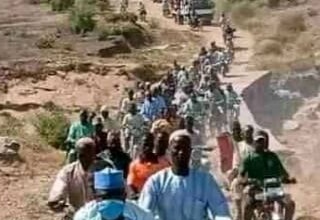
There are growing indications that suspected terrorists operating in parts of northern Nigeria are relocating in the aftermath of missile strikes carried out by the United States on Thursday night.
Credible community leaders disclosed that unusual movements were observed as the hoodlums began migrating in small groups after the Christmas Day attacks.
President Donald Trump had announced on Thursday that the US military conducted deadly strikes against Islamic State terrorists in northwestern Nigeria. The Federal Government later confirmed the operation, stating that Nigeria supported the strikes, which were executed on specific locations believed to be used by the terrorists.
Despite the attacks, no casualties were recorded at the two locations struck by the missiles. In Jabo, Tambuwal Local Government Area of Sokoto State, a missile landed on a farmland, while some buildings were affected in Offa, Kwara State.
Officials of Tangaza Local Government Area in Sokoto State, however, said further missile strikes were carried out on suspected hideouts of the Lakurawa armed group in parts of the Sokoto axis. Although no deaths were reported, several residents sustained injuries, while properties worth millions of naira were destroyed. Similarly, no fatalities were recorded in Offa, though residents were injured and properties damaged.
READ ALSO:’How U.S. airstrikes stopped terrorists from Mali, Burkina Faso from attacking 4 North-West states’
Influx of bandits in Benue
The Chairman of the Traditional Council in Gwer West Local Government Area of Benue State, Daniel Abomtse, raised concerns over the influx of armed herders into some communities following the US strike.
Speaking to one of our correspondents on Saturday, the traditional ruler said he observed the presence of armed herders within his domain.
He said, “I felt their movement in my local government as well as in Agatu LGA. They have been running away from Sokoto to coastal areas in Gwer West and Agatu with sophisticated arms and grazing openly. They are in my domain.”
While commending the US strike, Abomtse appealed to Trump to extend similar operations to Benue, Kogi, Taraba, Niger and Plateau states.
“What President Trump has done is the best thing to have happened to the government of Nigeria. I commend him for dealing with the menace in the country, which began about 16 years ago,” he added.
Efforts to confirm Abomtse’s claims from the spokesperson for the Benue State Police Command, Udeme Edet, were unsuccessful, as calls to her phone were not answered and messages were not returned as of the time of filing this report.
Sokoto terrorists in disarray
Security sources and residents said the Christmas attacks had disrupted bandit operations and forced them to abandon their hideouts.
Community leaders in Tangaza, Gudu and parts of Illela in Sokoto State said there had been noticeable signs of dislocation and movement among armed groups since the strike.
Some of the leaders, who spoke anonymously, said bandits were seen moving in smaller groups toward remote forest corridors, while others were believed to be attempting to cross into neighbouring border communities to evade aerial and ground surveillance.
A community leader in Tangaza said the airstrike “sent a strong signal” and compelled criminal elements to abandon familiar routes and camps.
“People are cautious, but there is relief that their hideouts were hit,” he added.
Officials of the Sokoto State Government said intelligence assessments were ongoing to determine the direction and scale of bandit movements after the strike. A senior official said security agencies had been placed on high alert to prevent terrorists from infiltrating relatively safe communities, noting that border patrols and joint operations with federal forces were being intensified to block escape routes.
A security expert, Bashar Umar, said the state government, working with the military and other security agencies, was strengthening surveillance across flashpoints, particularly in border local governments, to curb terrorist movement.
Meanwhile, a United States congressman, Riley Moore, said the strikes helped prevent “deadly Christmas attacks in Nigeria.” Moore, who made the statement on Saturday via X, noted that Christians in Nigeria had been killed during the last two Christmas seasons.
“This year, thanks to @POTUS, radical Islamic terrorists were on the receiving end of 12 Tomahawk missiles as a present.“The successful strikes on ISIS, in coordination with the Nigerian government, are just the first step to secure the country and end the slaughter of our brothers and sisters in Christ,” Moore added.
It was also learnt that the US had resumed surveillance operations in the Sambisa Forest, Borno State. A Sahel-focused terrorism tracker, Brant Philip, disclosed this on X on Saturday, sharing flight-tracking data that showed an aircraft operating over Borno State.
According to the post, the aircraft was identified as a Gulfstream V, a long-range business jet commonly adapted for intelligence, surveillance and reconnaissance missions.
“The United States resumed ISR operations today on ISWAP in the Sambisa forest, Borno State in North-East Nigeria, after a pause of one day following the strikes in Sokoto State,” he wrote.
Terrorists dislocated, may seek international support — experts
A security analyst and Chief Executive Officer of Beacon Consulting, Kabiru Adamu, said fleeing terrorists might attempt to blend with law-abiding citizens.
Adamu, who resides in Sokoto, warned that the terrorists could also seek backing from international terror groups and governments sympathetic to their ideology. He urged security agencies to boost surveillance to track movements and prevent infiltration of safe areas.
He said, “There is going to be dislocation after the US strike. The terrorists will leave known locations and most likely try to integrate with law-abiding communities.“They will also spin a narrative that a Christian country, the United States, is attacking Muslims in Nigeria. They will not say they are terrorists but will use this to gather support or sympathy.
“They will seek support from other terror groups around the world, including membership, tactics and funding. Nigeria may become a theatre of terror conflict as a result.“Propaganda is another strategy they will adopt after the attacks, especially in cyberspace. They are likely to release fake news and propaganda materials to drive support and attract funding and membership.”
Similarly, a Professor of Political Science and Defence Studies at the Nigerian Defence Academy, Kaduna, Tar Usman, said the US military offensive would distract terrorists from planning and executing attacks as they come to terms with the involvement of a powerful global ally.
According to him, uncertainty over possible future strikes would heighten fear within terrorist camps and disrupt their operations.
“We do not know when next they (US) will strike, so there will be panic in the camp of the terrorists, and that is a good one for us because it will distract them from carrying out their notorious activities,” he said.
Usman explained that insurgent groups often exploit periods of calm to plan attacks but noted that the current situation could deny them that opportunity. He cautioned, however, that the intervention would not immediately end terrorism, warning that the groups could adapt new tactics.
He said, “I can also see a situation where they will try to disappear and mix with the public, but with vigilance, I hope our intelligence agencies would intercept them.“We should not be under any illusion that they will abandon their notorious activities instantly. Maybe in the fullness of time, we will see the full impact of the US intervention.”
(PUNCH)


Nigerian Army varsity professor dies in captivity month after abduction

KEDCO bemoans electricity supply challenges in North-West, seeks FG’s intervention

Niger: Illegal Miners kill NSCDC officer, torch patrol vehicle in Kataeregi

Nigerian trapped in Russian military camp begs FG for urgent repatriation

Why naira may soon exchange below N1,000 per dollar – Otedola

JUST IN : El-Rufai evades arrest at Abuja airport

A life of honour and service: Celebrating 35 years of meritorious policing – The pulling out of AIG Danjuma Aboki

BREAKING: Senate adopts electronic, manual transmission of election results

FG to commence sale of state-owned assets – Minister

Naira outperforms Dollar in remarkable comeback

Electoral Act Amendment: ‘Akpabio is the real issue, Tinubu’s lapdog’ — El-Rufai

How EFCC arraigned suspects who allegedly collected ₦603m from a Woman to facilitate NNPC GMD Appointment

Why I Resigned As NAHCON Chairman – Usman


