
News
How Ivory Coast evacuated Jonathan from Guinea-Bissau amid Nigerian govt’s delay

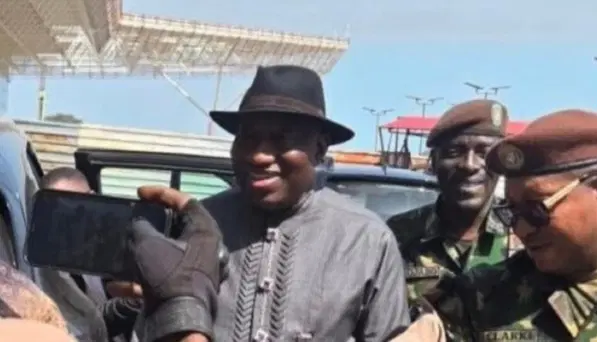
Ivory Coast on Thursday facilitated the evacuation of former Nigerian President Goodluck Jonathan from Guinea-Bissau, where he had been stranded following a sudden military takeover.
The swift intervention by Abidjan once again highlighted what many see as Nigeria’s increasingly sluggish approach to diplomatic crises.
While the Ivorian authorities moved decisively to assist a visiting African statesman, Nigeria’s response appeared slow and lacked clear coordination, despite Jonathan’s stature as a former president and his role as an ECOWAS envoy.
According to information obtained yesterday, the Ivorian government had already arranged for its presidential aircraft to retrieve Jonathan. Some aides close to President Bola Tinubu reportedly contacted a member of Jonathan’s team in Abuja, rather than initiating communication through Nigeria’s top diplomatic channels.
“It was the Côte d’Ivoire government that reached out to President Jonathan and they have provided an aircraft that’s bringing him back,” a source said.
Although Abuja eventually made contact, the Ivorian authorities had already completed preparations to return Jonathan to Nigeria. Officials also clarified last night that contrary to earlier claims, the soldiers responsible for the coup were not involved in escorting Jonathan out of the country. Instead, ECOMOG personnel drawn from Nigeria, Ghana and Senegal provided security from his hotel to the airport. “You will see that it was a presidential jet with the Republic of Cote d’Ivoire mark,” the source added.
READ ALSO:How Obama influenced my loss in 2015 – Jonathan reveals
By late Thursday, Jonathan—who had travelled to Guinea-Bissau as Head of the West African Elders Forum (WAEF) as part of an international observer team—had safely returned to Nigeria. He and several other observers had been stuck on Wednesday after the military seized control just as election results were about to be announced. A faction of officers had claimed “total control” a day after both leading candidates, President Umaro Embalo and Fernando Dias, each declared victory.
The group, calling itself the “High Military Command for the Restoration of Order,” suspended the electoral process “until further notice,” shut all borders, and imposed a night curfew.
On Thursday, the military named Maj.-Gen. Horta Inta-a as transitional leader, marking yet another political upheaval in Guinea-Bissau—its ninth coup or attempted coup in West and Central Africa in five years. The troubled nation, long plagued by instability and illegal drug trafficking, again found itself under uniformed rule.
The self-styled “High Military Command for the Restoration of Order” announced in a televised address that President Umaro Sissoco Embalo had been removed, claiming—without elaboration—that the decision stemmed from a destabilisation plot involving politicians and drug barons.
Flanked by senior officers during his first public appearance, Inta-a insisted the power grab was needed to thwart a scheme by “narcotraffickers” to “capture Guinean democracy.”
He said the transition would span one year, beginning immediately. Later in the day, he appointed Maj.-Gen. Tomas Djassi as army chief of staff. The coup erupted just before provisional results were due in the closely watched contest between Embalo and Dias, a 47-year-old newcomer who had emerged as the president’s top challenger.
(THISDAY)


2027 : Atiku opens up on alleged talks with Makinde over vice-presidential slot

INEC seeks N1.04tr for off-cycle, 2027 elections, urges early release of funds

2 Nigerian men killed while fighting for Russian army in Ukraine

Wike : Gov Fubara dissolves Rivers Executive Council

Judge steps down from EFCC cases against Malami, gives reason

Africa needs vibrant leaders aged 25–50, says Jonathan

Nigerian Army varsity professor dies in captivity months after abduction

BREAKING: Senate adopts electronic, manual transmission of election results

FG to commence sale of state-owned assets – Minister

How EFCC arraigned suspects who allegedly collected ₦603m from a Woman to facilitate NNPC GMD Appointment

Why I Resigned As NAHCON Chairman – Usman

NAHCON chairman resigns amid controversy

2027: Makarfi, Lamido step in as PDP Rift deepens at crucial Kaduna meeting


